

Introduction
The Assured Career Progression (ACP) Scheme was introduced to address career stagnation among government employees who do not receive regular promotions despite long years of service. Instead of waiting indefinitely for promotional vacancies, eligible employees receive financial upgradations that improve their pay while allowing them to continue in the same post.
Later, the Government of India introduced the Modified Assured Career Progression Scheme (MACP) following the recommendations of the 6th Central Pay Commission, and it continues under the 7th Central Pay Commission (7th CPC).
This guide explains the ACP scheme eligibility and benefits, the Modified Assured Career Progression Scheme (MACP), financial upgradation rules, pay fixation, benchmark requirements, pension implications, and the latest DoPT guidelines.
What Is the Assured Career Progression (ACP) Scheme?
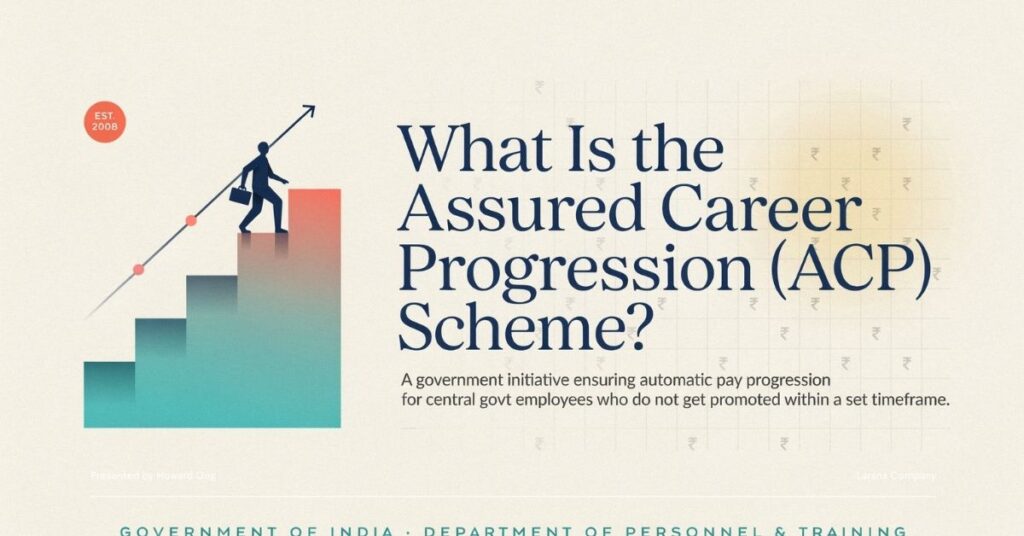
The Assured Career Progression Scheme is a career advancement policy that grants financial upgradation to eligible government employees who remain without regular promotion for a specified period.
Unlike a regular promotion, ACP improves the employee’s salary and pay level without changing their designation or job responsibilities.
Objectives of the ACP Scheme
- Reduce career stagnation
- Improve employee morale
- Ensure fair salary progression
- Reward long and satisfactory service
- Maintain parity among government employees
Evolution from ACP to MACP

Initially, employees received benefits under the ACP Scheme. However, after recommendations of the 6th Central Pay Commission, the Government replaced ACP with the Modified Assured Career Progression Scheme (MACP).
ACP vs MACP Timeline
| Scheme | Introduced | Financial Upgradations | Basis |
| ACP | 1999 | 2 | Promotional hierarchy |
| MACP | 2008 | 3 | Pay Matrix Level |
ACP Scheme Eligibility and Benefits
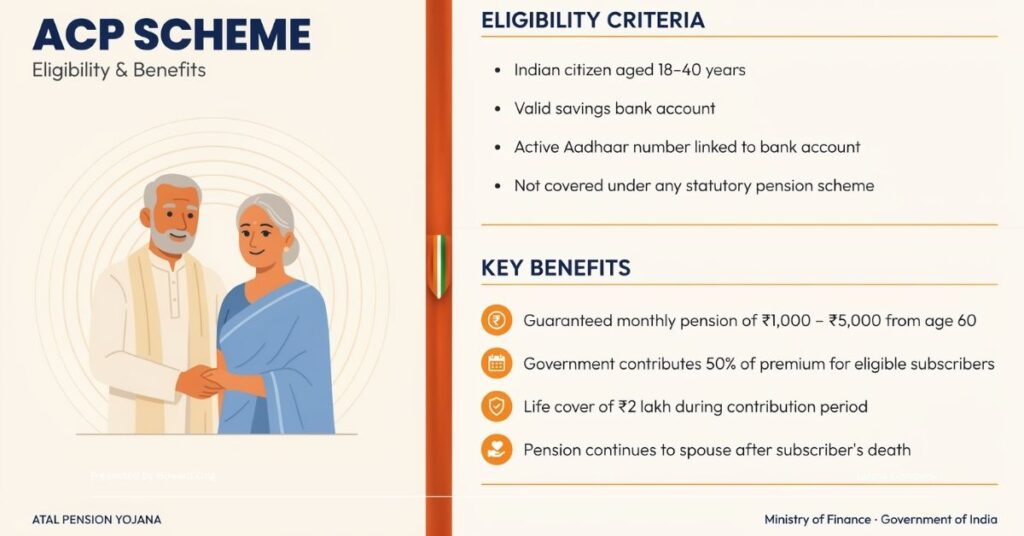
Employees must satisfy specific eligibility conditions before receiving financial upgradation.
Eligibility Criteria
An employee generally must:
- Complete the required years of regular service
- Hold a regular appointment
- Meet prescribed APAR benchmark ratings
- Have no disciplinary penalties affecting eligibility
- Receive clearance from the Screening Committee
Key Benefits
Employees enjoy several advantages under ACP/MACP.
Financial Benefits
- Higher Basic Pay
- Better Pay Matrix Level
- Annual increment advantage
- Increased DA, HRA, TA and other allowances
Retirement Benefits
Financial upgradation also positively affects:
- Pension
- Gratuity
- Leave encashment
- Commutation value
Modified Assured Career Progression Scheme (MACP)
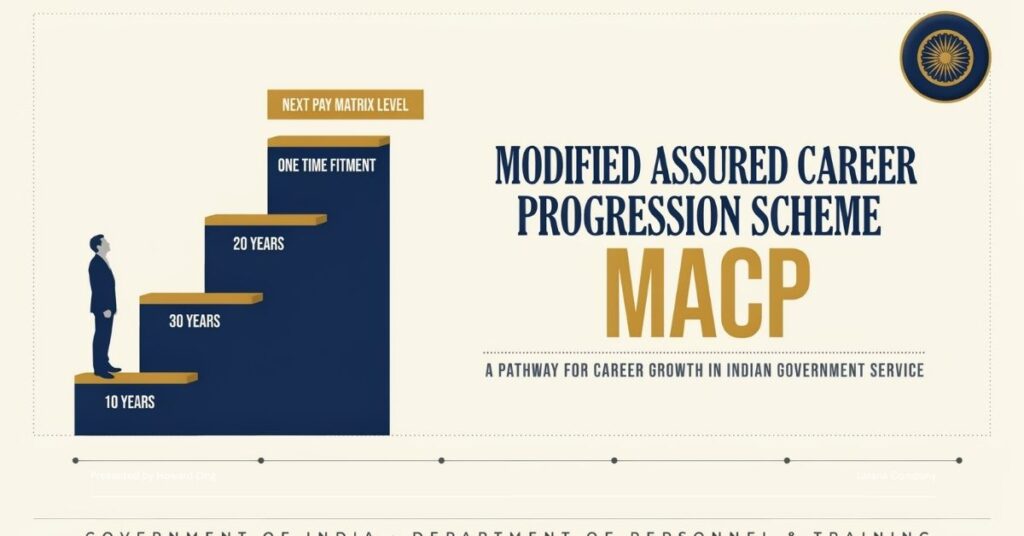
The Modified Assured Career Progression Scheme (MACP) grants three financial upgradations after completion of:
- 10 years
- 20 years
- 30 years
provided the employee has not received regular promotions.
MACP Financial Upgradation Schedule
| Years of Regular Service | MACP Benefit |
| 10 Years | First Financial Upgradation |
| 20 Years | Second Financial Upgradation |
| 30 Years | Third Financial Upgradation |
Difference Between Promotion and ACP Upgradation
Many employees confuse financial upgradation with promotion.
| Feature | Regular Promotion | ACP/MACP |
| Designation Changes | Yes | No |
| Duties Change | Usually | No |
| Salary Increase | Yes | Yes |
| Seniority Changes | Yes | No |
| Vacancy Required | Yes | No |
Key Point: ACP or MACP only improves the employee’s financial position and does not change the official designation.
ACP Pay Scale Hierarchy
Under the old ACP scheme, financial upgradation followed the promotional hierarchy.
Under MACP, movement occurs in the next higher Pay Matrix Level instead of promotional posts.
Example:
| Existing Level | MACP Level |
| Level 4 | Level 5 |
| Level 5 | Level 6 |
| Level 6 | Level 7 |
Financial Upgradation Rules in Government Jobs
Employees must fulfill several conditions before financial upgradation becomes effective.
Important Rules
- Continuous regular service counts.
- Extraordinary Leave (EOL) may affect calculations depending on applicable rules.
- Penalties can postpone MACP.
- APAR benchmark must meet prescribed standards.
- Screening Committee approval is mandatory.
- DoPT guidelines govern implementation.
Benchmark APAR Ratings
Performance plays an important role.
Typical Benchmark Requirements
| Assessment | Eligible |
| Outstanding | Yes |
| Very Good | Yes |
| Good | Depends on applicable rules |
| Average | Generally No |
Employees should always verify benchmark requirements according to the latest DoPT instructions.
Role of the Screening Committee
The Screening Committee examines:
- Length of service
- APAR ratings
- Vigilance clearance
- Disciplinary record
- Promotion history
- Previous financial upgradations
Only eligible employees receive MACP approval.
Pay Fixation Under 7th CPC
After financial upgradation:
- Existing Basic Pay is identified.
- One increment is granted.
- Employee moves to the next Pay Matrix Level.
- Revised Basic Pay is fixed at the appropriate cell.
This process follows relevant provisions of the CCS (Revised Pay) Rules and DoPT instructions.
Original Data Analysis: 10 vs 20 vs 30-Year Financial Impact Matrix
The following example illustrates how timely promotions compare with MACP-based financial progression.
| Service Length | Regular Promotions | MACP Only |
| 10 Years | First Promotion | First MACP |
| 20 Years | Second Promotion | Second MACP |
| 30 Years | Third Promotion | Third MACP |
| Pension Impact | Higher if promotional post carries greater benefits | Improved over stagnation but may differ from promotional hierarchy |
Key Observations
- MACP protects employees from salary stagnation.
- Regular promotions may still provide broader career advantages.
- Pension benefits generally improve after financial upgradation.
- Early financial progression significantly influences lifetime earnings.
Case Study Series: Navigating Stagnation & APAR Benchmark Upgradations
Case Study 1: Delayed Screening Committee
An employee completed 10 years of service but the department delayed the Screening Committee meeting. After submitting a formal representation and citing applicable DoPT instructions, the department granted the benefit with retrospective effect.
Lesson
Employees should maintain records of service completion dates and follow up promptly.
Case Study 2: APAR Benchmark Upgrade
An employee initially failed to meet the benchmark due to an adverse APAR entry. After successful representation and review, the upgraded APAR enabled MACP approval.
Lesson
Employees have the right to seek review where permissible under applicable rules.
Case Study 3: Incorrect Service Calculation
The department excluded qualifying service incorrectly. After verifying appointment records and submitting documentary evidence, the employee received overdue financial upgradation.
Lesson
Always verify service books and tenure calculations before eligibility dates.
The 4-Stage Service Audit Methodology for MACP Readiness
Employees can perform a self-audit before completing 10, 20, or 30 years.
Stage 1 – Verify Service Records
- Appointment date
- Joining report
- Service book
- Previous promotions
Stage 2 – Review APAR
Check:
- Benchmark ratings
- Missing reports
- Communicated remarks
Stage 3 – Examine Service Interruptions
Review:
- Extraordinary Leave
- Suspension period
- Break in service
- Penalties
Stage 4 – Confirm Financial Upgradation Status
Ensure:
- Previous ACP/MACP benefits
- Correct Pay Matrix Level
- Proper pay fixation
- DoPT compliance
Non-Functional Financial Upgradation (NFFU)
Certain organized Group ‘A’ services may receive Non-Functional Financial Upgradation (NFFU) under separate government rules.
Although NFFU and MACP both improve financial status, they operate under different eligibility conditions and should not be confused.
Pensionary Benefits Impact
Financial upgradation often increases retirement benefits because it enhances the employee’s Basic Pay.
Potential benefits include:
- Higher pension
- Increased gratuity
- Better leave encashment
- Improved commutation value
Multimedia Resources for Better Understanding
Interactive Pay Upgradation Calculator
Readers can estimate:
- Next MACP due date
- Expected Pay Matrix Level
- Estimated Basic Pay
- Financial impact
Decision Tree: Are You Eligible?
The decision tree should help employees verify:
- Years of regular service
- APAR benchmark
- Promotion history
- Penalty status
- Screening Committee eligibility
Explainer Video
Suggested Topic
A Simple Guide to MACP Pay Fixation Under Rule 13
The video should explain pay fixation with practical examples using the Pay Matrix.
Downloadable Templates
Provide ready-to-use templates for:
- Representation for delayed MACP
- Pay fixation correction request
- APAR review application
- Service record verification request
Best Practices for Employees
- Maintain copies of service records.
- Review APAR every year.
- Track MACP eligibility dates.
- Verify pay fixation orders.
- Keep copies of DoPT circulars relevant to your cadre.
- Submit representations promptly if discrepancies arise.
Author
Hamza – Senior HR & Public Administration Specialist
Former Administrative Officer / Retired Personnel Directorate Manager
With over 22 years of experience handling civil service cadres, service rules, and administrative pay fixation under the 6th and 7th Central Pay Commissions, Hamza has directly processed 3,500+ ACP and MACP cases across central government departments.
They work as an independent service rules consultant, regularly publishing practical guides on DoPT circulars, pay matrix revisions, service regulations, and career progression policies.
Conclusion
The Assured Career Progression Scheme and the Modified Assured Career Progression Scheme (MACP) play a crucial role in protecting government employees from prolonged career stagnation. By ensuring timely financial upgradations, these schemes improve salary progression, enhance retirement benefits, and reward long, satisfactory service even when promotional opportunities remain limited.
Employees should regularly review their service records, monitor APAR benchmarks, understand DoPT guidelines, and verify pay fixation to ensure they receive all eligible benefits under the 7th Central Pay Commission. A proactive approach can prevent delays, strengthen representation in case of disputes, and help maximize long-term financial security.
(FAQs)
1. What is the Assured Career Progression (ACP) Scheme?
ACP is a government scheme that grants financial upgradation to employees who do not receive regular promotions within the prescribed period.
2. What is the difference between ACP and MACP?
ACP followed the promotional hierarchy, while MACP provides financial upgradation based on the next Pay Matrix Level.
3. How many financial upgradations are available under MACP?
Eligible employees may receive three financial upgradations after completing 10, 20, and 30 years of regular service.
4. Does MACP change the employee’s designation?
No. MACP improves pay but does not change the employee’s designation or job responsibilities.
5. Is APAR important for MACP?
Yes. Employees must meet the prescribed benchmark ratings under applicable DoPT guidelines.